THIRD QUARTER INSIGHTS – August 6, 2026

around the office
Summer always brings out the travel bug around here, and this year was no exception. Our team scattered far and wide over the past few months — reeling in a big catch offshore, chasing sunsets on the rocks in Hawaii, exploring the reef a few fathoms down, and settling for a friendly (if hard-fought) round of mini golf closer to home. We also had a family escape room adventure, a round of golf with old friends, a summer wedding to celebrate, and — biggest news of all — a brand-new addition to one of our families! It’s always fun to come back to the office and swap stories, photos, and a few too many souvenirs. Here are a few of our favorite snapshots from the summer:






different risks, same playbook
by RYAN THOMASON, CFA, Portfolio Manager
The first half of 2026 had no shortage of factors that drove markets down and then back up again. We witnessed increased volatility from the war in Iran, oil prices pushing inflation to multi-year highs (and then back down), and a new Fed chair taking the helm. Now in August, markets have had new concerns to digest, from AI investment questions, rising treasury yields, renewed oil price volatility, and a more fragmented Fed. Many of these are longer-term themes that could keep driving volatility in the months ahead. Yet these same trends have also propelled markets this year, which underscores how much diversification still matters within portfolios.
Key Market and Economic Drivers in July
- The S&P 500, Nasdaq, and Dow Jones Industrial Average returned -0.06%, -3.19%, and 0.38% in July, respectively. Year-to-date, they’ve returned 10.14%, 9.53%, and 10.17%.
- Volatility jumped mid-July, with the VIX index climbing as high as 21 before settling back toward 16 at month-end.
- Oil prices rose, with Brent crude climbing above $100 before closing the month at $90 a barrel and WTI at $85.
- Second-quarter GDP grew at an annual rate of 1.5%, down from 2.1% in the first quarter.
- At the July FOMC meeting, the Federal Reserve kept rates unchanged at 3.50-3.75% in a 9-3 vote.
AI Investments Across the Tech Sector
Second quarter corporate earnings raised new questions around AI investment, with renewed skepticism about free cash flow at large technology companies (the hyperscalers). These companies continue to pour hundreds of billions of dollars into new data centers and AI infrastructure, and investors are increasingly asking whether that spending will translate into profits. At the same time, data center spending alone has become a meaningful contributor to U.S. economic activity, surpassing all other categories of office construction. Concerns over this level of investment have spilled into international markets too, especially among global semiconductor companies. Major chip suppliers had a rough month, which contributed to a sharp decline of 22% in South Korea’s KOSPI index in July.
Another AI development in July was the release of a new large language model, Kimi K3, from the Chinese company Moonshot. This model reportedly competes with some of the most advanced models from companies like OpenAI and Anthropic. Since it’s an “open weight” model, anyone with the right hardware can run it themselves, unlike most U.S. models, which remains proprietary. This echoes last year’s DeepSeek moment, which showed that AI models can be built more efficiently than expected, raising fresh questions about future hardware and infrastructure needs, as well as which country ends up leading the AI race.
While AI has grabbed the headlines, plenty of other sectors have performed well this year too, including Energy and Industrials, among others. This serves as a good reminder to not be too concentrated in whatever theme is popular at the moment. Balancing across sectors is what tends to drive durable long-term returns.
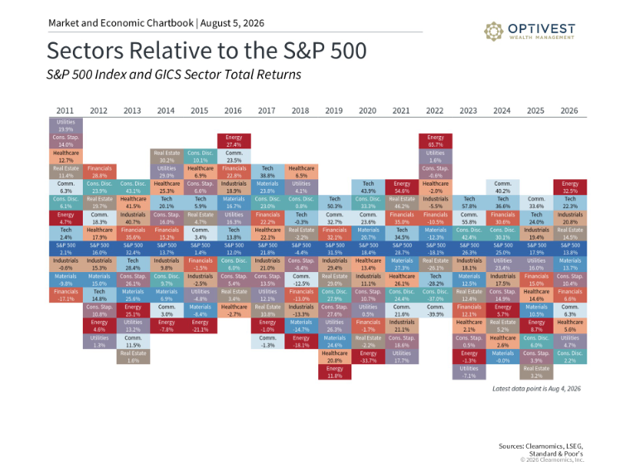
S&P 500 Index and GICS Sector Total Returns
Oil and the Middle East
The ongoing conflict in Iran also drove short-term market moves. Tensions reignited mid-month when the U.S. conducted more airstrikes against Iranian military sites, slowing traffic through the Straight of Hormuz. Brent crude jumped above $100 in response before settling back to $90 at month-end, a sharp increase from the $72 low it touched in early July. Higher energy prices matter for the broader economy because they directly raise fuel costs for households and businesses. Gasoline prices are still hovering around $4.10 a gallon nationally, which could keep headline inflation elevated.

WTI and Brent Crude
The Federal Reserve Holds Rates
At its July meeting, the FOMC kept the federal funds rate unchanged in a range of 3.50%-3.75%, despite concerns over higher inflation. That decision pushed bond yields higher as investors tried to gauge when the Fed might start raising rates again.
Fed Chair Kevin Warsh has intentionally scaled back communication about how the Fed might act at future meetings. Not only is the FOMC statement much simpler now, but he’s avoided answering questions about how the Fed might respond to different economic scenarios. That removal of forward guidance means investors may have less clarity on how the Fed will respond to higher inflation or a slower labor market.
The immediate reaction to the Fed’s decision and Warsh’s remarks was a jump in bond yields, with both nominal and real Treasury rates climbing to their highest levels in recent years. Market-based expectations have priced in a rate hike by October, and possibly two more in 2027. It is worth remembering that market expectations can shift quickly on new information. While it is helpful to track, it is not a crystal ball for what the Fed will actually do.
Another notable outcome from the July meeting was three Fed officials dissenting in favor of a rate hike. This represents a level of internal disagreement that has been rare in recent years, with the last instance dating back to September 2016. For markets, that’s a signal of what the Fed may be weighing at upcoming meetings, especially if inflation stays elevated.

Target range lower limit
Looking Ahead
The back half of the year looks set to carry many of the same tensions that defined July: an AI trade that markets are still trying to price correctly, a Fed that’s more divided and less predictable than it’s been in years, and an Iran conflict that keeps injecting volatility into oil and energy prices. The specific risks have shifted from what worried us six months ago, and they’ll likely shift again before year-end. But the playbook hasn’t changed. Markets rarely move in a straight line, the underlying economy is still growing, corporate earnings have beat expectations, and portfolios spread across different asset classes have continued to weather the swings. Different risks, same playbook: we’ll be watching the Fed’s next moves, energy markets, and how AI spending plays out in the numbers, and we’ll keep positioning portfolios the way we always have, built to handle whatever comes next, not just what we’re worried about today.

the best estate plan still needs full tables at thanksgiving
by MATT McMANUS, M.A., CFP®, Partner
How Grandparents can turn good intentions into real time together
Most of the conversations we have with grandparents start with a legal question: how to structure a trust, how much to gift this year, whether a 529 plan or a custodial account makes more sense for a grandchild’s education. Those questions matter, and we spend a great deal of time helping clients get the technical details right. But almost every one of those conversations eventually drifts toward a different, more personal question — usually asked a little more quietly than the tax questions: how do you actually stay close to the people you’re planning for?
It’s a fair question, and an increasingly common one. Families are more spread out geographically than they used to be. Adult children are juggling careers, young kids, and often in-laws with competing claims on the calendar. A well-drafted trust can provide for grandchildren financially for decades. It cannot, on its own, get everyone around the same table more than once or twice a year. That takes intention, not paperwork — and, encouragingly, it’s often easier to build than people expect once they know where to focus their energy. What follows are some of the approaches we’ve seen work well for the families we serve, along with a few of the quieter pitfalls that tend to undo them.
Build Rituals, Not Just Occasions
Big trips and holiday gatherings are memorable, but they’re also rare, expensive, and often high-pressure — the kind of event everyone feels they have to show up for, perform at, and recover from. Families who stay genuinely close tend to lean less on these big set pieces and more on small, recurring touchpoints that require almost no planning at all: a standing Sunday afternoon call, a monthly dinner that happens whether or not every single person can make it, an annual long weekend that’s simply understood, without much discussion, to be “the family trip” year after year.
The common thread across all of these is that they’re low-stakes and repeatable. Nobody needs to coordinate six calendars or book flights eight months in advance for a Sunday phone call. And because the ritual repeats, missing it once doesn’t feel like a rupture — there’s always next week. A shared family group chat or a running photo album can do something similar in the background: it keeps a quiet thread of connection alive between visits, so that time together doesn’t have to start from zero every time everyone reconnects.
Give Visits a Purpose
A visit framed as “we should go see Mom and Dad” can start to feel like an obligation rather than something to look forward to, especially for adult children who are already stretched thin juggling careers and young kids of their own. Visits built around a shared activity tend to land very differently — they give everyone something to do together, not just a room to sit in and make conversation. A few approaches that tend to work well:
- Passing down a skill — a family recipe, fishing, woodworking, baking, gardening, even a card game with its own family-specific house rules — gives every generation a role to play, not just the adults doing the talking while children wait to be excused.
- Family history projects, like recording oral histories, digitizing old home movies, or sorting through boxes of photographs together, give grandchildren a genuinely interesting reason to want to be there, and often surface stories that even adult children have never heard before.
- Gathering somewhere new — a rented house, a cabin, a shared destination neither generation calls home — can remove the unspoken “host and guest” dynamic that sometimes builds up around the family house, where one household is always cooking, cleaning, and entertaining while everyone else simply arrives.
- Even something as small as a recurring family project — a jigsaw puzzle left out on a table, a running jar of family jokes, a garden bed that gets tended every visit — gives a visit texture and continuity from one trip to the next.
Remove the Friction
Many adult children want to visit more often than they actually do; in our experience, the barrier is usually logistics, not desire. Coordinating travel with young children, missed school days, work schedules, and the cost of flights for a family of four or five adds up quickly, and it’s often enough to make a family quietly default to “maybe next time.”
Grandparents who actively remove friction tend to see meaningfully more time together, simply because they’ve made it easier to say yes. That might mean offering to help cover travel costs when finances allow, doing some of the traveling themselves rather than always expecting the family to come to them, or staying flexible about timing — a quiet weekday visit instead of only competing for a slot during the already-crowded major holidays, when adult children are often also splitting time with in-laws. None of these gestures need to be grand; even offering to keep a stocked guest room ready, or picking up the airport pickup and drop-off without being asked, can lower the activation energy required for a visit to happen at all.
Give Grandchildren Their Own Reasons to Want to Come
Children and teenagers who have their own genuine pull toward a visit end up creating pull on their parents, too — a grandchild who’s excited to go is a grandchild whose parents hear about it all week beforehand. An ongoing project that only continues when they’re physically there — a garden bed they’re responsible for, a scrapbook they’re slowly filling in, a woodworking piece that’s a little further along each visit — gives a grandchild something concrete to look forward to between trips, rather than a vague sense that they’re supposed to enjoy themselves once they arrive.
A little bit of ownership tends to go a long way as well: a bedroom that’s genuinely theirs and stays that way between visits, toys or books that live only at the grandparents’ house and nowhere else, a nickname or in-joke that belongs only to that relationship. Taken together, these small signals build a sense that the grandparents’ home is a second home, not somewhere they’re merely a well-behaved guest. And where possible, carving out one-on-one time with an individual grandchild — even just an afternoon, without siblings along — often deepens a relationship faster than any number of full-family group gatherings, simply because the attention isn’t divided.
Protect the Relationship from the Planning
A quieter point, but in our experience one of the most important ones: families tend to stay closer when financial and estate planning conversations are kept clearly separate from ordinary family time. When visits start to feel tied, even loosely, to inheritance discussions — or when parenting choices are openly second-guessed during a visit — adult children often respond by pulling back, sometimes without fully realizing why. It’s rarely a dramatic falling-out; it’s more often a slow drift, a few more excuses, a visit that gets shorter or less frequent.
Warm, low-pressure invitations tend to be met far more warmly than ones that carry even a faint note of guilt or obligation. “We’d love to see you whenever it works” tends to land better than “we never see you anymore,” even when the underlying feeling is the same. If a difficult planning conversation does need to happen — about a trust, a health directive, a family business succession — many families find it helps to schedule that conversation deliberately, separately from a holiday or family trip, so that the visit itself doesn’t become associated with tension or negotiation.
None of this replaces the legal and financial planning that protects a family’s future — that work still matters enormously, and we’re always glad to help with it. But in our experience, the plans clients feel best about, years later, are the ones built alongside real relationships, not as a substitute for them. Sometimes the most valuable thing a grandparent leaves behind isn’t written into the trust document at all — it’s the standing Sunday call, the garden bed with three generations’ handprints in the dirt, and a family that still wants to show up.
This article is provided for general informational purposes and does not constitute legal, financial, or personal advice. Please contact our office to discuss your family’s specific circumstances.
giving from your ira: a great tool just got even better
by MATT McMANUS, M.A., CFP®, Partner
If you’re 70½ or older and love supporting the causes you care about, here’s some good news: the Qualified Charitable Distribution (QCD) is more valuable in 2026 than ever. The dollar limits went up, new tax rules make it even more attractive by comparison, and we’ve got clear answers on how it plays out at the state level for California, Utah, Virginia, and Tennessee. Let’s walk through it.
The basics, refreshed for 2026
A QCD is simply a direct gift from your IRA straight to a charity you love — your custodian sends it, so it never passes through your hands. Because it skips your tax return entirely, it counts toward your Required Minimum Distribution without bumping up your income.
How much you can give: up to $111,000 per person in 2026, or $222,000 for a couple who each have their own IRA. You also get a one-time option to direct up to $55,000 toward a charitable remainder trust or gift annuity — a nice option if that fits your plans, though it’s a once-in-a-lifetime election.
Who qualifies: you’ll need to be 70½ at the time of the gift, giving from a Traditional or Inherited IRA (401(k)s don’t count), and the gift needs to go to a public charity — donor-advised funds and private foundations aren’t eligible.
Why this year is an especially good year to give this way
New rules starting this year put a floor and a ceiling on regular itemized charitable deductions, which can chip away at the benefit for some givers. The QCD sidesteps both of those limits completely, since it works by excluding the gift from your income rather than deducting it. If you’re already taking RMDs and give generously, this makes the case for a QCD even stronger this year.
One more perk worth knowing: because a QCD keeps money out of your AGI, it can also help you stay under a Medicare IRMAA threshold — which means potentially lower Part B and Part D premiums next year.
How it works across state lines
The federal benefit is crystal clear. The good news is that it’s just as clear in the states we hear about most from you:

California, Utah, and Virginia all follow the federal rules here, so once your QCD is excluded federally, it stays excluded on your state return too — no extra steps needed. And in Tennessee, there’s no state income tax to worry about in the first place. If you split time in a state we haven’t mentioned, just give us a shout and we’ll check it for you.
The bottom line
A QCD lets you satisfy your RMD, support the charities you love, and keep the gift out of your taxable income entirely — and this year’s higher limits and new tax rules make it a smarter move than ever. If you’re married with two IRAs, remember you each get your own $111,000 to work with, and if a charitable remainder trust or gift annuity is on your radar, that $55,000 split-interest option is a once-in-a-lifetime opportunity worth timing carefully. Whatever state you call home, we’re happy to walk through the details with you. As always, this is a general overview rather than advice tailored to your situation — if giving is on your mind for the rest of the year, let’s talk it through together before you reach out to your custodian.
Respectfully,
Matt, Leslie, Ryan & Ashlee